

Summer in Dallas keeps air conditioners running for months on end. When temperatures climb into the upper 90s and stay there, homeowners start paying much closer attention to their energy bills. One of the most common questions we hear is simple: how many watts does an air conditioner actually use?
It depends on the type of system, its size, its efficiency rating, and how often it runs. Understanding your AC's power consumption helps you estimate operating costs, identify efficiency problems early, and make smarter decisions about repairs or replacement.
What Is a Watt?
A watt measures how much electricity an appliance uses. Your electric company bills you in kilowatt-hours, which track electricity consumption over time. Watts tell you how much power your air conditioner needs to operate, whereas kilowatt-hours show how much electricity it uses throughout the day. Higher wattage means the system draws more power to cool your home.
Average Watt Usage by Air Conditioner Type
Every cooling system draws a different amount of power.
Window air conditioners cool individual rooms and tend to be one of the most efficient options for smaller spaces. Smaller units typically use between 500 and 900 watts, while larger models generally require 1,000 to 1,500 watts.
Portable air conditioners provide flexibility but often consume more power than homeowners expect, usually ranging from 2,900 to 4,100 watts.
Ductless mini-splits have become increasingly popular in Dallas homes, garages, additions, and converted spaces. Most systems use between 700 and 2,000 watts. By cooling specific zones instead of the entire home, they can deliver meaningful energy savings.
Central air conditioners remain the most common cooling solution across North Texas. Small systems generally use 1,500 to 2,500 watts, mid-sized units fall between 2,500 and 3,500 watts, and larger systems may require 3,500 to 5,000 watts. Most Dallas homes operate three- to five-ton systems, placing them near the higher end of that range during peak summer temperatures.
Fan-only mode circulates air without engaging the cooling components and typically uses about 500 to 750 watts. Operating costs remain lower in this mode, though it will not reduce indoor temperatures.
Why AC Power Consumption Matters in Dallas
Electricity usage may not seem significant until the first major heat wave arrives. Dallas homeowners rely heavily on air conditioning from May through September. During periods of extreme heat, systems can run nearly nonstop throughout the afternoon and evening.
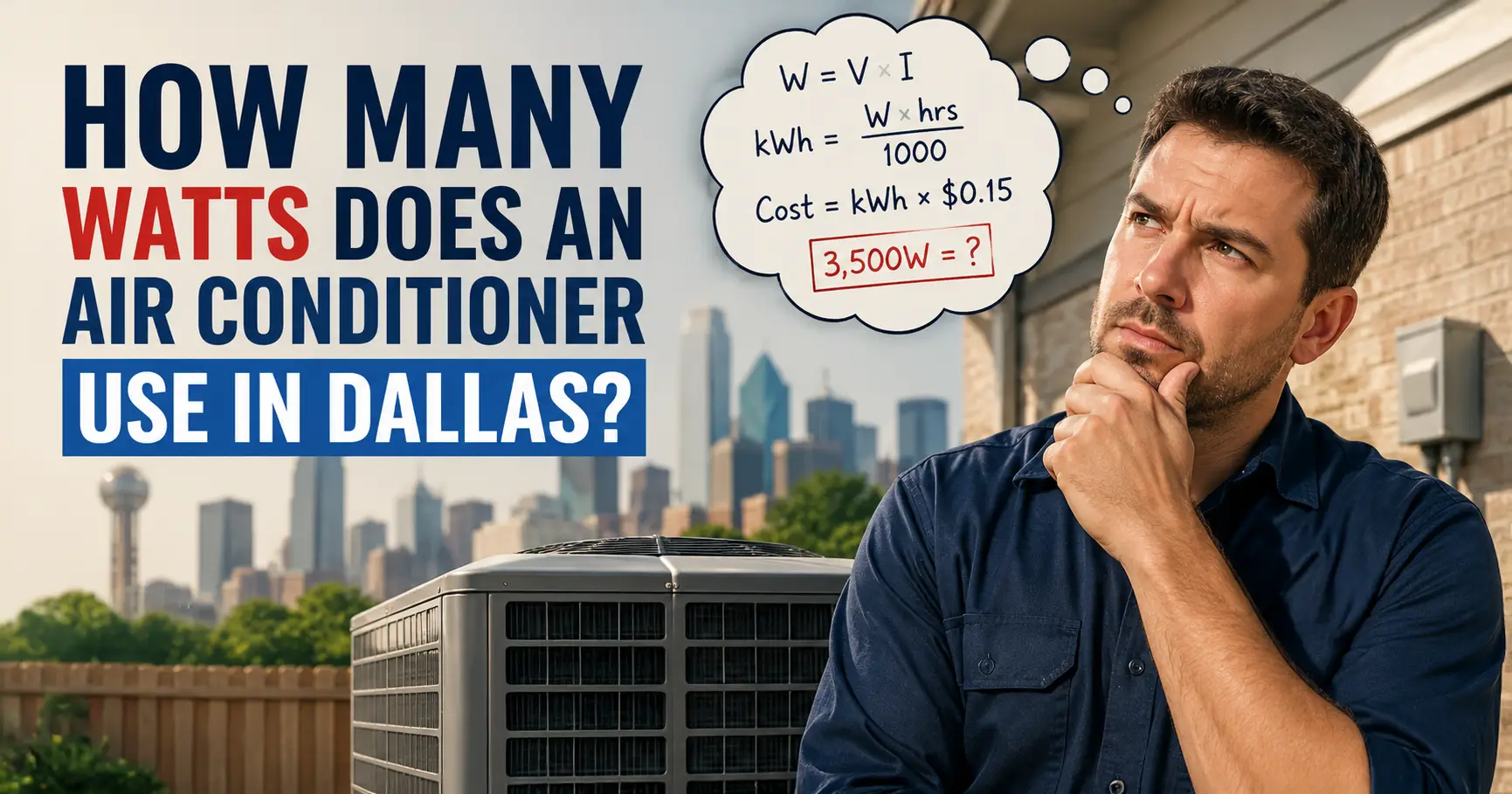
A central air conditioner drawing 3,500 watts for eight hours consumes roughly 28 kilowatt-hours in a single day. Over the course of a long Texas summer, that level of energy usage can have a noticeable impact on monthly utility bills.
What Affects Air Conditioner Wattage?
- System size: Larger systems use more electricity because they move more air and remove more heat.
- Efficiency rating: Higher SEER2 ratings allow systems to provide the same cooling while using less power.
- Outdoor temperatures: Triple-digit Dallas temperatures force air conditioners to run longer and work harder.
- Home insulation: Poor insulation allows cooled air to escape and outdoor heat to enter, increasing run times.
- Thermostat settings: Lower temperature settings generally increase energy consumption.
- Maintenance history: Dirty filters, clogged coils, airflow restrictions, and worn components reduce efficiency.
How to Estimate Your Energy Usage
You can estimate operating costs with a few simple numbers. Start by locating your system's wattage rating on the unit or in the owner's manual. Multiply that wattage by the number of hours the system runs each day, then convert the result into kilowatt-hours.
A 3,000-watt air conditioner running eight hours per day uses approximately 24 kilowatt-hours. At an electricity rate of $0.15 per kilowatt-hour, daily operating costs would be about $3.60. Actual costs depend on utility rates, outdoor temperatures, and system efficiency.
Signs Your AC May Be Using Too Much Electricity
Higher energy bills are often the first warning sign. Other indicators include:
- Longer cooling cycles
- Uneven temperatures throughout the home
- Reduced airflow from vents
- Frequent repairs
- Excess indoor humidity
- A system that is more than 10 to 15 years old
One Dallas homeowner recently contacted us after noticing a sharp increase in summer electric bills. The thermostat was functioning properly, but a heavily clogged evaporator coil had restricted airflow and forced the system to run almost continuously. After cleaning and servicing the equipment, cooling performance improved and energy consumption dropped noticeably.
How to Reduce AC Energy Usage
A system replacement is not always necessary to lower energy consumption.
- Change air filters regularly: Dirty filters restrict airflow and force the system to work harder.
- Schedule professional maintenance: Routine service helps identify efficiency problems before they become expensive repairs.
- Use a smart thermostat: Automatic temperature adjustments can reduce cooling costs without sacrificing comfort.
- Seal air leaks: Closing gaps around doors, windows, and attic access points helps keep conditioned air indoors.
- Upgrade older equipment: Modern systems often use significantly less electricity than aging units.
Is It Time to Upgrade Your Air Conditioner?
A system that struggles to cool your home, requires frequent repairs, or contributes to unusually high energy bills may be costing more than you realize. Modern air conditioners operate more efficiently, run more quietly, and manage humidity more effectively. Many Dallas homeowners notice lower utility costs after upgrading to a high-efficiency system.
If you're uncertain whether your current equipment is operating efficiently, a professional evaluation can provide clear answers.
At A/C Rescue, we help Dallas homeowners improve comfort, reduce energy waste, and keep cooling systems operating at peak performance throughout the hottest months of the year. Whether you need maintenance, repairs, or a complete replacement, our team can help you find the most efficient solution for your home.